
Mechanical Ventilation (VMC): Health in your home
Renew your home's air 24 hours a day without losing energy or opening windows.

What is VMC and why do you need it on the Costa del Sol?
Double-flow mechanical ventilation (VMC) is a system that continuously renews the indoor air of your home automatically, without needing to open windows. It extracts stale air from humid areas (bathrooms, kitchen, utility room) and replaces it with fresh, filtered outdoor air, distributing it to the main rooms. The key to its efficiency lies in the heat recovery unit: a heat exchanger that transfers the temperature of the outgoing air to the incoming air, so in winter the fresh air enters pre-heated and in summer it enters pre-cooled, preventing energy loss.
On the Costa del Sol, where many modern homes are designed with excellent insulation levels and hermetic double-glazed windows, traditional natural ventilation is no longer sufficient. A well-insulated but poorly ventilated home becomes a closed container where humidity, CO₂, volatile organic compounds (VOCs) from furniture and cleaning products, and allergens accumulate. VMC is the technical solution to guarantee optimal indoor air quality without wasting the energy you invest in heating or cooling your home.
Problems that VMC solves in your home
- Window condensation and wall mould: In winter, the temperature difference between the warm interior and the cold exterior causes condensation on glass. If humidity is not evacuated, mould appears in corners and behind furniture, causing structural damage and respiratory problems.
- Persistent bad odours: Cooking, tobacco, or pet odours accumulate in a home with inadequate ventilation. VMC extracts them at the source, renewing the air continuously.
- Stuffy air and excess CO₂: In closed bedrooms, CO₂ levels rise during the night, causing poor sleep, headaches, and a feeling of heaviness upon waking. VMC keeps CO₂ levels below the 1000 ppm recommended by the World Health Organization.
- Allergies and asthma: VMC with HEPA or F7 filters traps pollen, dust, and mites from the outdoor air before introducing them into the home, creating a healthy environment for allergy sufferers.
- Interstitial condensation damp: In homes with internal insulation, moisture can condense inside the wall, causing structural rot. VMC maintains relative humidity at healthy levels (40-60%).
How does a double-flow VMC system work?
The system consists of the following elements:
- Ventilation unit (recuperator): Installed in the false ceiling (usually in the bathroom, storage room, or utility area) and contains two fans (one for extraction and one for supply) and the heat exchanger.
- Duct network: Small-diameter pipes (75-90 mm) installed in the false ceiling. One circuit extracts stale air from bathrooms and kitchen, and another distributes fresh air to bedrooms and living room.
- Grilles and diffusers: Extraction vents in humid areas and supply vents in rooms, adjustable to balance air flows.
- Filters: Air filters that trap particles and pollen. They must be cleaned or replaced periodically.
- Controls: Control panel or smartphone app to adjust flows according to needs (away mode, party mode, kitchen boost, etc.).
The heat recovery unit can achieve an efficiency of up to 90%, meaning 90% of the thermal energy from the extracted air is transferred to the incoming air. This makes VMC an especially efficient system when combined with aerothermal or a heat pump, as it minimises the energy losses associated with ventilation.
When to install VMC in your Marbella home?
VMC is especially recommended in the following cases:
- New builds: This is the ideal time, as the ducts integrate into the false ceiling without additional building work. Furthermore, the Technical Building Code (CTE) requires mechanical ventilation systems in many cases.
- Full renovations: If you are renewing the false ceiling, taking the opportunity to install VMC is a smart decision.
- Homes with damp problems: If you suffer from condensation, mould, or poor air quality despite having good insulation, VMC is the definitive solution.
- People with allergies or asthma: Filtering the incoming air drastically improves the quality of life for allergy sufferers.
Frequently asked questions about VMC
Does VMC consume a lot of electricity?
No. High-efficiency fans consume between 15 and 40 W in continuous operation, less than a light bulb. The energy savings provided by recovering heat from the extracted air more than compensates for the electrical consumption.
Is it noisy?
Modern systems are designed to be very quiet. The ventilation unit is installed in a service area (bathroom, storage room) and the room diffusers barely produce an inaudible whisper.
Do I need to open windows if I have VMC?
It is not necessary for ventilation, but you can do so whenever you want to enjoy the open air. VMC guarantees constant renewal of indoor air without needing to open windows, which is ideal for homes in noisy areas or with security concerns.
Breathe cleaner air without opening windows
We install double-flow VMC systems in new builds and full renovations in Marbella and the Costa del Sol. Request a personalised study with no obligation.
Related Articles

How AC Duct Cleaning Drastically Improves Your Health and Quality of Life
Dirty air ducts are the perfect hiding place for mold and mites. Discover why professional cleaning is vital for your family's health.
Indoor Air Quality: Why It Matters for Your Family
The air inside your home can be up to 5 times more polluted than outside. Find out how to fix it and protect your loved ones.
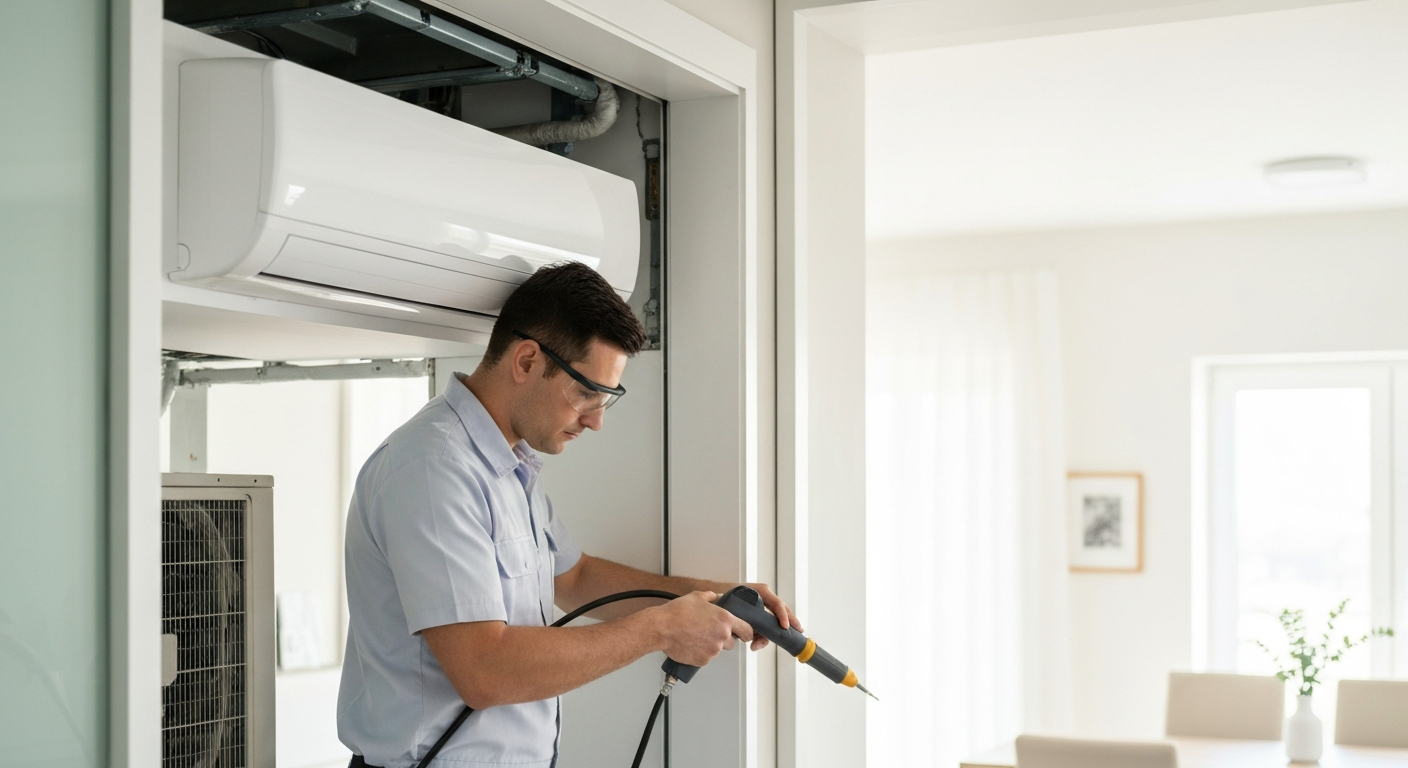
Removing Mold and Odors from Your AC System
If your AC smells musty or like vinegar when you turn it on, you have a mold problem. We explain how to eradicate it definitively.