
HVAC for Restaurants on the Costa del Sol: Complete Guide
How to balance kitchen extraction with dining room comfort for a perfect experience that invites customers to stay.
The Challenge of Negative Pressure in Commercial Kitchens
Commercial kitchen extractor hoods pull out massive amounts of air laden with smoke, heat, and grease to the outside. If the restaurant's HVAC system doesn't replenish that air in a calculated and efficient manner, a phenomenon called "negative pressure" occurs. This causes outdoor air to rush in when the front door is opened, creating uncomfortable drafts for diners, and worse, causing kitchen odors and heat to invade the dining room. Balancing airflow is the critical first step in any hospitality climate control project.
Cassette and Ducted Systems: Uniform Cold Distribution
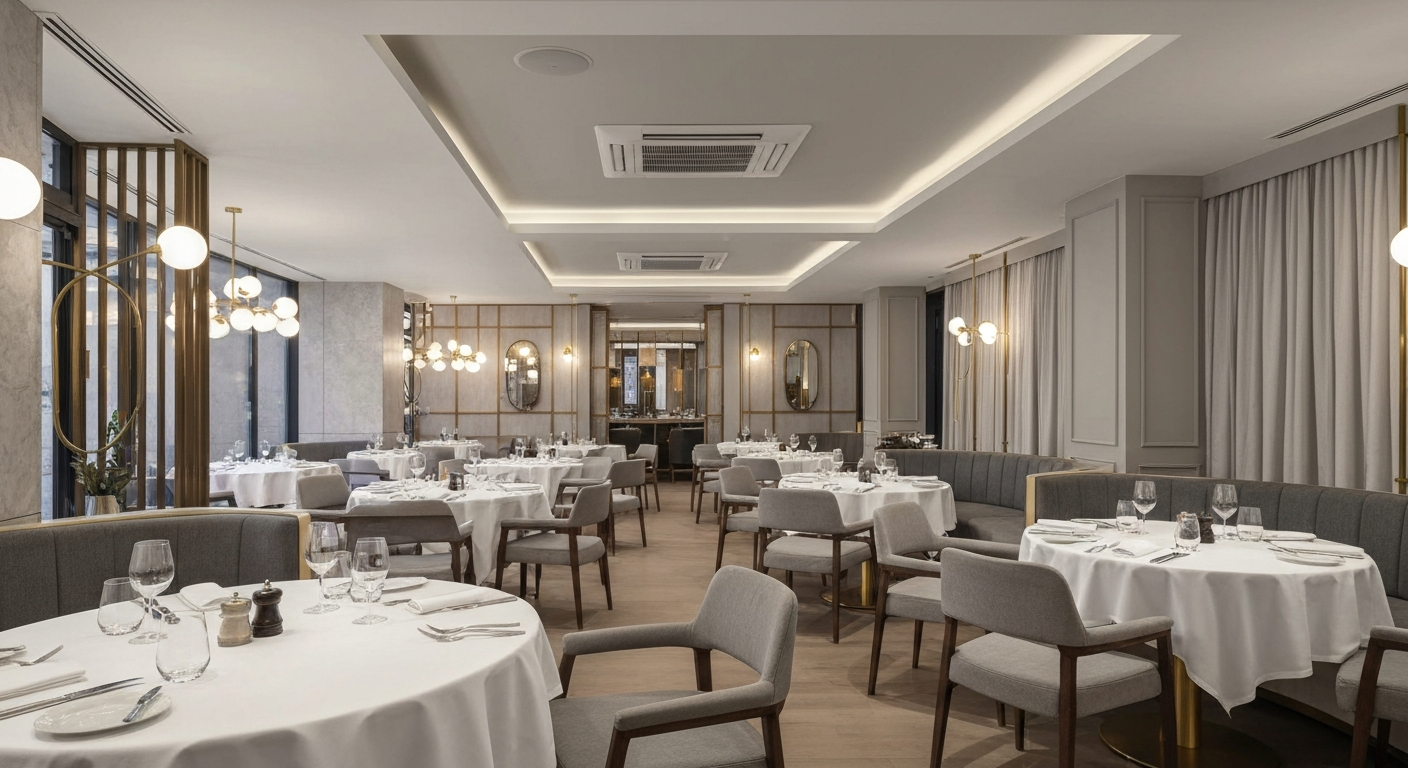
In the dining room, thermal comfort must be absolutely uniform. A customer receiving a direct blast of freezing air on the back of their neck will ask to turn the AC off, while the customer at the next table will sweat. To avoid this, 4-way Cassette systems or a well-designed duct network are essential. These systems distribute air smoothly and envelopingly across the ceiling. If you need to upgrade your venue, our commercial HVAC team in Marbella will design a balanced system that guarantees comfort in every corner of your restaurant.
Humidity Control and Odor Filtration
On the Costa del Sol, outdoor humidity combined with kitchen steam can turn your restaurant into a sticky sauna. A good commercial HVAC system not only cools the air but acts as a powerful dehumidifier. Furthermore, incorporating high-efficiency (HEPA) filters or ionic purification technology in the dining room returns helps neutralize any residual food or musty odors, ensuring your customers enjoy the aroma of their meals, and nothing else.
Smart Zoning for Different Areas
A restaurant does not have the same thermal needs in all its areas. The bar area, with more movement and heat from coffee machines, requires more cooling than a private indoor dining room. The area near south-facing windows will heat up much faster at noon. Installing VRF (Variable Refrigerant Flow) systems allows you to divide the restaurant into independent zones, automatically adjusting the temperature based on the thermal load of each area in real-time, which also maximizes energy savings.
Improve your diners' experience
A cool, pleasant environment is just as important as the quality of your food. Request an HVAC audit for your restaurant today and ensure the success of your season.
Contact Hospitality ExpertsRelated Articles

Why HVAC Maintenance is Vital for Restaurants in Marbella
Prevent an AC failure from ruining your restaurant's service during peak season.
VRF Systems: The Best Choice for Office Buildings
Discover why Variable Refrigerant Flow (VRF) is the modern standard for office climate control.
Hotel Air Conditioning: Key to Guest Comfort
A quiet and efficient air conditioning system is fundamental to securing 5-star reviews for your hotel.